PEA Tax After 5 Years: How French Social Contributions Actually Work
What changes at the 5-year mark, why 17.2% remains, how the CSG/CRDS/social levy breakdown works, and the small habits that make the most of the wrapper.
Note for non-French residents: This article covers the PEA — a 100% French tax wrapper that doesn't have a direct equivalent in other systems. If you live in France or hold a PEA from a prior period of residency, this is directly applicable. If you live elsewhere but follow French personal finance — or are considering a move — you'll find the underlying mechanics useful for understanding how long-term tax wrappers work in general.
The 5-year mark on a PEA is where the wrapper goes from "good" to "great." You move from a 30% tax bill on your gains to 17.2%. But that 17.2% throws a lot of people off — they expected "tax-free" and got "tax-reduced." This article walks through what actually changes at the 5-year mark, why 17.2% sticks around, and the small habits that make the most of the wrapper over the long term.
This article is informational and educational. Patrice is a wealth-tracking and decision-support tool, not a conseiller en gestion de patrimoine (CGP) or investment advisor. The French tax rules described reflect law as of June 2026 and may change with each finance act (loi de finances). For decisions specific to your situation, consult a licensed CGP or a chartered accountant (expert-comptable).
The 5-year clock in 3 minutes
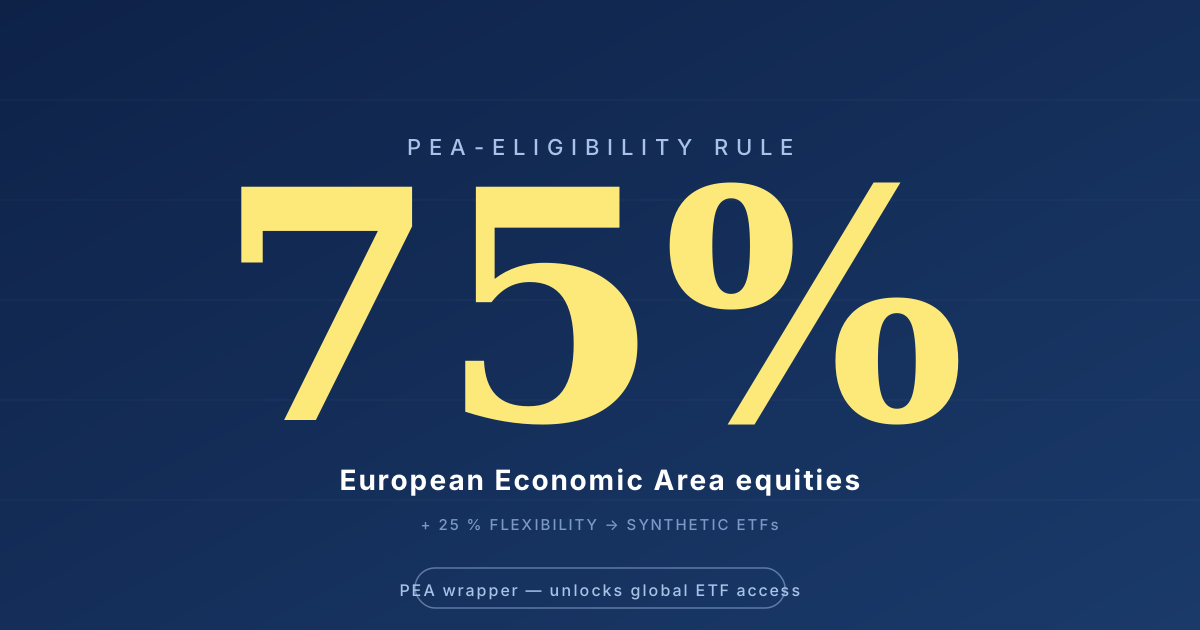
The PEA (Plan d'Épargne en Actions) is a French tax wrapper dedicated to European equities. What makes it special isn't what you can hold inside — it's how gains are taxed after a 5-year holding period.
When the clock starts
The clock starts the day you open the PEA, not the day you make your first big deposit. This is the single most useful thing to know about the wrapper. Open one early — even with €100 you don't immediately need — and the clock starts ticking. Five years later, you've earned your tax break without having to predict your investment strategy in advance.
Before 5 years
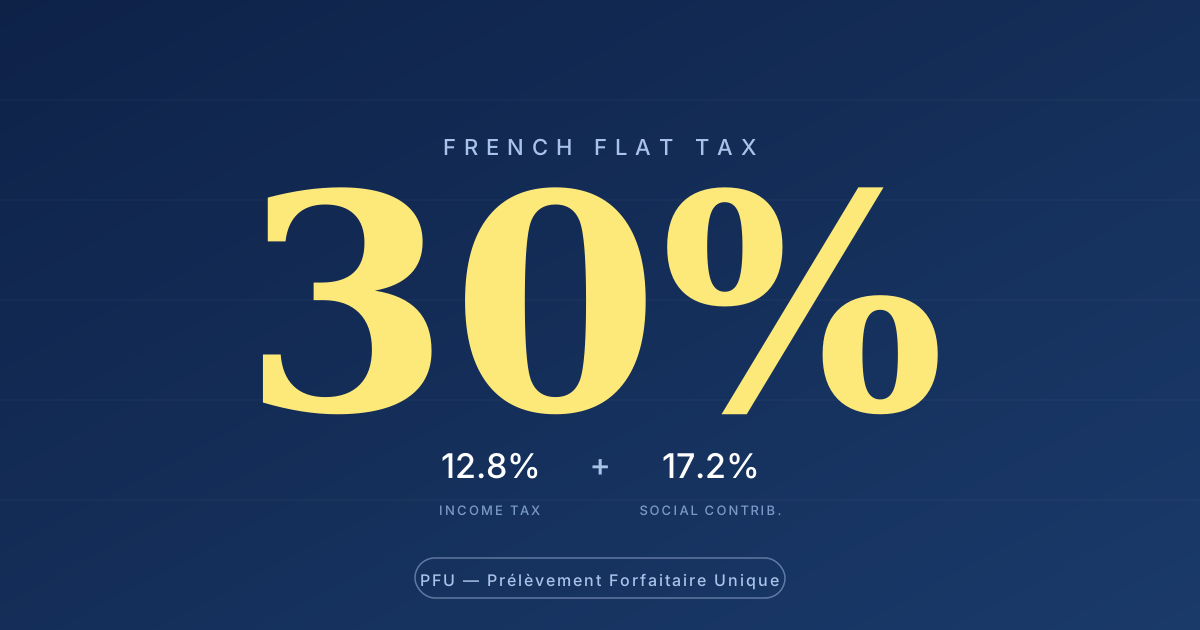
Any withdrawal closes the PEA. Your gains are then taxed under the standard regime: 30% total, split into 12.8% income tax and 17.2% social contributions (more on those below).
After 5 years
Withdrawals are free — partial or full, no forced closure. Gains are subject only to the 17.2% social contributions. No income tax. That's a 12.8 percentage point saving compared to a regular brokerage account (compte-titres ordinaire, or CTO).
What "17.2% social contributions" actually means
If you grew up in the UK or US, "social contributions" sounds vague. In France, it's not — it's a precise stack of three small taxes, all earmarked for social spending.
CSG (9.2%) — health, family, retirement
The Contribution Sociale Généralisée funds social security: hospitals, family allowances, retirement. Created in 1991, it's now the single biggest source of social funding in France.
CRDS (0.5%) — paying down social debt
The Contribution au Remboursement de la Dette Sociale was created in 1996 to pay off the accumulated debt of the French social security system. Originally meant to be temporary. Still here, three decades later.
Solidarity levy (7.5%) — the top-up
The prélèvement de solidarité funds various additional social programs. It replaced several smaller levies in 2018 — a simplification, but at a higher rate than what came before.
Why none of these go away
The 17.2% is often confused with income tax. It's not. It's a separate stack of social taxes that the PEA wrapper does not exempt you from. Income tax (the part the PEA does exempt after 5 years) depends on your bracket; social contributions are a flat rate that applies to almost all investment income for French tax residents — regardless of your bracket, your wealth, or how long you've held the asset.
Politically, social contributions are also harder to cut than income tax. Reducing income tax is a feel-good measure; reducing social contributions means cutting hospital funding or pensions. So when finance acts "lower taxes," it's almost never these.
A worked example
You open a PEA at 30 with €100. You contribute €300/month for 25 years. At an average gross return of 7%/year, you reach age 55 with roughly €240,000 in the account — of which about €150,000 is gains (cumulative contributions total €90,000).
You decide to withdraw the full amount at 55 — to fund a house purchase, top up retirement, whatever the reason.
Tax owed: 17.2% × €150,000 in gains = €25,800.
Had the same flow gone through a standard brokerage account (CTO), with 30% PFU applied each time you sold to rebalance: the tax bill would have reached roughly €45,000. The saving from using the PEA wrapper: about €19,000.
Illustrative example only. Actual returns vary, taxes depend on your individual circumstances, and the tax framework may change.
Practical tips
The small habits that compound into real savings over a 20-30 year horizon.
Take the date early
Open your PEA as soon as you can, even with a token deposit. €100 starts the 5-year clock just as well as €100,000. You can't shift the clock earlier in retrospect — but you can absolutely keep a low-activity PEA going for years and then ramp up contributions when you're ready.
Make partial withdrawals, not full closures
After 5 years, you can withdraw part of your PEA and leave the rest invested. The wrapper stays open, the clock keeps running on what's left. Avoid the common reflex of "closing the PEA to take money out" — that's only the rule before 5 years.
Track gains separately from contributions
Your gains are what's taxed, not the whole withdrawal. If you've contributed €100,000 and your PEA is worth €130,000, your gain is €30,000. The 17.2% applies to that €30,000, not to the €100,000. Knowing your real gain at any time lets you anticipate the actual tax bill on any withdrawal. This is the kind of thing that's easy to lose track of when you have multiple deposits over many years — which is exactly why a consolidated wealth view saves you guesswork.
Be careful if you change tax residency
The PEA is a French wrapper. If you become a non-resident, the rules shift — sometimes favorably (no French income tax), sometimes not (some countries don't recognize the French wrapper and tax you as if it were a regular brokerage). If a move abroad is on the horizon, a 30-minute chat with a tax professional before anything changes is worth the cost.
Don't let the wrapper distort your strategy
The PEA tax break is real, but it's a percentage of your gains. If choosing the PEA pushes you into worse investments — less diversified, more concentrated in European equities than your risk tolerance warrants — the tax saving can be eaten by suboptimal performance. The wrapper should serve the strategy, not the other way around.
Tracking your PEA in the broader picture
Your PEA isn't an isolated number on a quarterly statement. It's one piece of your overall wealth picture — sitting alongside your assurance-vie, your SCPI, your savings, your real estate. Knowing what the post-tax value of your PEA actually is (gross value minus the 17.2% on unrealized gains) gives you the real number to plan with.
For a deeper look at how the PEA works as a wrapper, see our article on PEA & ETFs in France. For the big picture of how every asset type is taxed in France, see Taxing Wealth in France.
Common questions
Is PEA really tax-free after 5 years? No. Income tax is exempt, but the 17.2% social contributions remain. "Tax-reduced" is more accurate than "tax-free."
What if I close my PEA before 5 years? Closure triggers the standard PFU regime — 30% on your gains (12.8% income tax + 17.2% social contributions). There's no extra penalty in the modern PEA (since the 2019 reform), but you lose the tax break and reset the clock if you reopen one.
Are dividends inside the PEA taxed? Not while they stay inside. Dividends and capital gains reinvested in the PEA accumulate tax-deferred. Tax only applies when you withdraw — and only on the gain portion. This compounding-without-friction effect is what makes the wrapper so effective long-term.
What if I become a non-resident? The treatment depends on your destination country's tax treaty with France. In some cases the PEA continues to grow and is taxed only on withdrawal; in others, your new country may tax the wrapper as a regular brokerage. This is a case where individualized advice matters.
Does the 17.2% apply to all my PEA gains, or only what I withdraw? Only on what you withdraw. The wrapper allows gains to compound untouched. Your "potential tax liability" grows with your gains, but it's only realized when you take money out.
Final thoughts
The PEA after 5 years isn't a magic tax-free account — but it's the most efficient way to build long-term European equity exposure in France, by a significant margin. The 17.2% is real, but it's stable, predictable, and applies only on the gain portion when you actually withdraw.
The biggest wins come from small habits: opening early, withdrawing partially instead of fully, tracking your real gain separately from your nominal value. Most investors lose more to closing a PEA prematurely than they ever do to the 17.2% itself.
Reminder: this article is informational, not investment or tax advice. For your specific situation, a CGP or chartered accountant is the right person to talk to.